- Tanim Prodhan
- Posts
- Plow → Factory → Cloud: How the Agrarian, Industrial and Information Ages Changed Everything (and what to do about it)
Plow → Factory → Cloud: How the Agrarian, Industrial and Information Ages Changed Everything (and what to do about it)
“From Plow to Processor: The Three Ages and Why Your Schooling Might Need a Rewrite”

Timeless Success Secrets
December 20, 2025
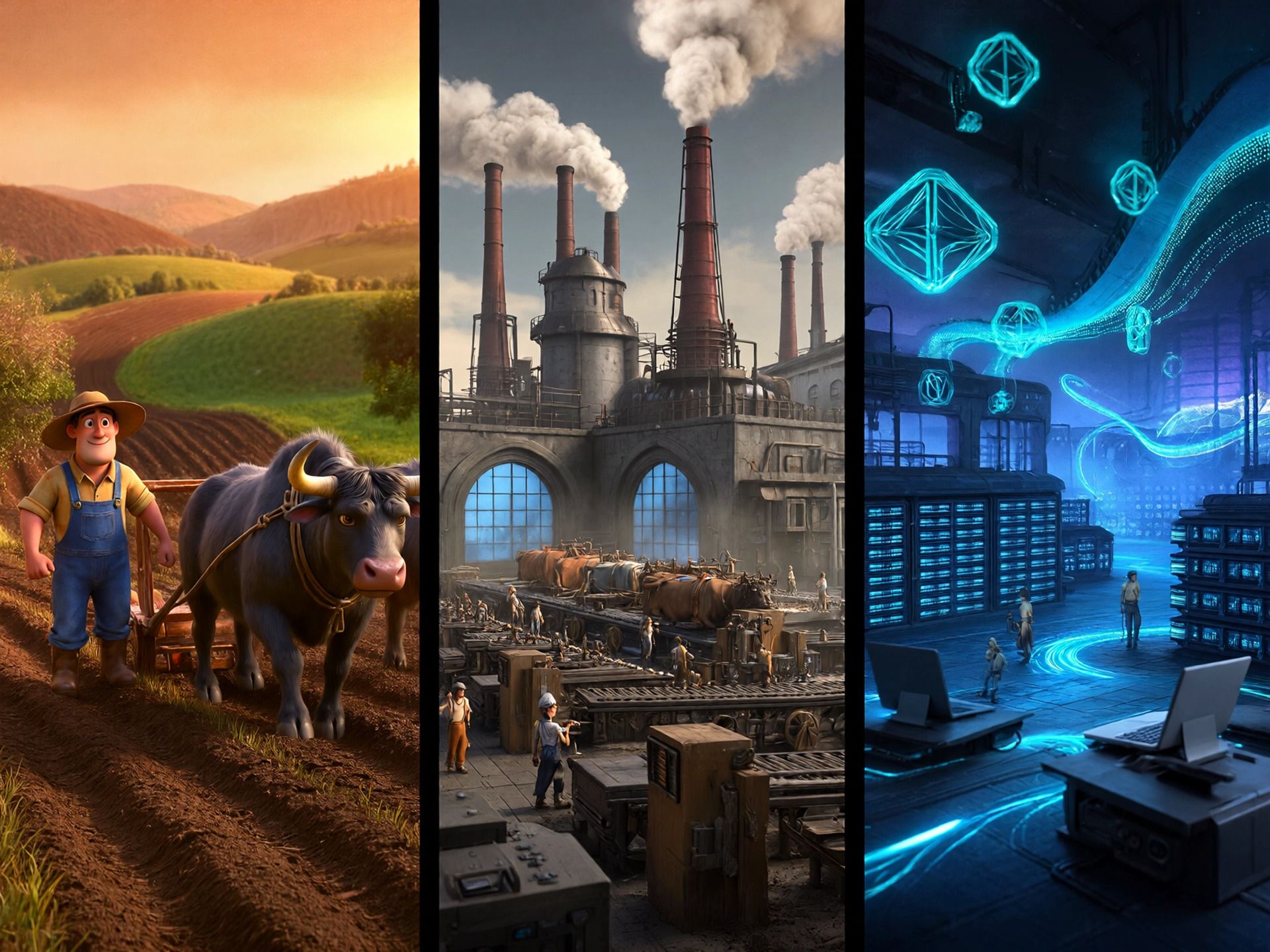
For centuries, the question “What should I learn?” had a predictable answer. Today that answer changes every 3–10 years. If you don’t understand how the ages changed the rules, you’ll keep playing yesterday’s game.
The three ages — a deep, practical view
Agrarian Age (pre-1500s → local economies)

Agrarian Age
🌾 Agrarian Age —
The Agrarian Age was a time when almost all economic value came directly from the land. Wealth depended on crops, livestock, and the ability to work the soil, so families focused on farming skills that were passed down for generations with little change. Life was local; communities relied on manual labor, simple tools, and predictable seasonal cycles. Because technology moved slowly, the knowledge you learned as a young adult stayed useful for your entire lifetime. Stability came from land ownership — if you controlled fertile land, you controlled your economic future. In this age, education was practical, hands-on, and rarely needed major updates.
What mattered: fertile land, seasonal cycles, local craftsmanship.
Skills that lasted: farming techniques, basic trades, local market knowledge.
Why it was stable: low technological churn; knowledge passed from generation to generation.
Example: A blacksmith who learned to shoe horses and repair ploughs could remain useful locally for decades.
Industrial Age (approx. 1500 → ~2000)
⚙️ Industrial Age —
The Industrial Age transformed economies by shifting value from farmland to factories, machinery, and large-scale production. People left rural areas for cities where they could work in manufacturing plants, railroads, and growing industries like automobiles, aviation, and electronics. A new middle class emerged as companies offered long-term jobs, labor unions protected workers’ rights, and many employers provided lifelong pensions. The education system adapted to supply disciplined, specialized workers who could perform repetitive or technical tasks for decades. Because industries changed slowly, a degree or trade skill learned early on often supported someone’s entire career with minimal retraining. In this era, job security and employer-funded retirement were the norms.

Industrial Age
What changed: factories, mass production, centralized industry and urbanization.
New assets: large-scale industrial land, factories, standardized labor.
Social shift: emergence of a large middle class, lifelong employment with firms, labor unions, employer pensions.
Education model: go to school, get a cert/degree, join a company — those school skills saw long useful lifetimes.
Example: If you trained as an accountant or machinist in 1960, your career skillset likely remained relevant for decades, often with predictable promotion paths and employer pensions.
Information Age (≈1989 → present)

Information Age
💻 Information Age —
The Information Age shifted value again—this time from machines to information, technology, and digital networks. With the rise of the internet, software, automation, and now artificial intelligence, routine jobs can be outsourced or replaced faster than ever before. This era rewards adaptability, continuous learning, and the ability to work with rapidly evolving tools. Traditional job security weakened, pensions disappeared in many countries, and individuals became responsible for their own financial education and retirement planning. Skills now have shorter lifespans, and a person may need to relearn or reskill multiple times throughout their career. In the Information Age, speed of learning matters more than the specific skill itself.
What changed: internet, networks, software, and now AI — information and automation became core productive assets.
Consequences: job roles change rapidly, firms offshore or automate routine work, lifetime pensions become rare, the individual carries more retirement risk.
New priority: ability to learn fast, adapt, and combine skills (technical + human skills). Financial literacy moves from “nice to have” to essential.
Example: A software library or automation can replace tasks that once took a full team; the person who can integrate, manage and choose systems becomes valuable — but only if they continually learn.

Why school served people longer in older ages —
Slow rate of change (Agrarian/Industrial): Curricula matched long-lived industries. If you trained in a trade or profession, the workplace didn’t radically transform from year to year, so your schooling had long shelf-life. Example: a high-school-trained electrician in 1970 kept earning stable wages across decades.
Predictable employers and benefits (Industrial): Companies offered structured careers and pensions. That reduced the need for ongoing financial education — the employer handled retirement planning. Example: government jobs or unionized manufacturing roles often included defined-benefit pensions.
Why it’s different now: Today, tools, regulation and global competition change industries quickly. A skill you learn can become partly obsolete in a few years (or require a new toolset). Example: a marketing manager who learned only TV ad buying in 1990 must learn digital analytics in 2005 and AI tools by 2025.
Practical examples of real life
Factory worker, 1970s → steady job, retire with a company pension.
Factory worker, 2020s → automation or relocation risk; must reskill into maintenance, programming, or a new role.

Then Vs. Now
Doctor (Industrial Age example): Historically valued for firm credentials and long careers; today doctors still earn well but must continually learn new medical tech, telemedicine, and adapt business models.
Small-business owner then vs now: A grocery owner could rely on local foot traffic for decades; today they must manage online orders, delivery logistics, and social media to remain competitive.
What to change now — rules for the Information Age (actionable guide)
Invest in learning agility: schedule weekly “micro-learning” — 3×30-minute focused learning blocks per week.
Places to learn from:
Subscribe here: https://timeless-success-newsletter.beehiiv.com/
or,Visit: https://richdad.com/
Mix technical + human skills: pair a hard skill (data tools, AI basics, investing) with soft skills (selling, communication, systems thinking).
Build multiple income channels: keep a stable job but develop a side project that can scale (digital product, rental income, syndication).
Start financial education now: learn basic cashflow, risk, leverage and tax fundamentals — not to get rich quick, but to protect and grow purchasing power.
Plan for shorter skill half-lives: expect to learn at least one major new capability every 3–7 years.
Key lessons
The “one-school-one-job” model is obsolete for many fields.
Speed of learning determines long-term employability.
The right-side mindset (systems, assets, leverage) becomes more useful than the left-side mindset (security, paychecks).
Financial responsibility has shifted from employers/governments to individuals. To learn about it, click the link below 👇:

By the way:

The Rich constantly educate themselves on matters of money.
If you want a different lens on all this, Robert Kiyosaki’s Cashflow Quadrant reframes how the economy moved from employer responsibility to personal responsibility. It’s not a how-to investment manual — it’s a map for switching the way you think about work and money. If you’re ready to change the rules you live by, start there.

A bonus for you:
Want to know about the beliefs of the “Industrial Age” and the “Information Age“? Then grab the bonus by clicking the link below 👇:
Disclaimer:
🚨 Alert — educational only: This newsletter is for informational and educational purposes and does not constitute financial, tax or legal advice. Always consult a licensed professional before making financial decisions.
Actionable Guide:
Week 0: pick one tech or financial concept to study (e.g., Excel + basic investing).
Weeks 1–12: 3×30 minutes/week learning blocks.
Month 4: build a tiny project (spreadsheet, blog post, small side offer).
Month 6: evaluate if you can monetize or scale.
To read more on:

The Secret Advantage of the Rich: Changing the Tax Game
Building Your Own Ladder: How Entrepreneurs Raise Capital
"The Money Trap: Why Earning More Won’t Set You Free"
If you are enjoying the newsletter so far then consider joining the newsletter as we share many things on finances and lessons. These are clearly not investment advices but lessons. I share what I learn from books and I add other educational things too. You will like joining my newsletter. You can also read the other ones that I have written too. Join my newsletter with the link below👇:
